John McAfee
Antivirus pioneer who claimed to hold "31+ terabytes of incriminating data" on government corruption. Found hanged in a Spanish prison cell on June 23, 2021, hours after a court approved his extradition to the United States. His widow disputes the suicide ruling.
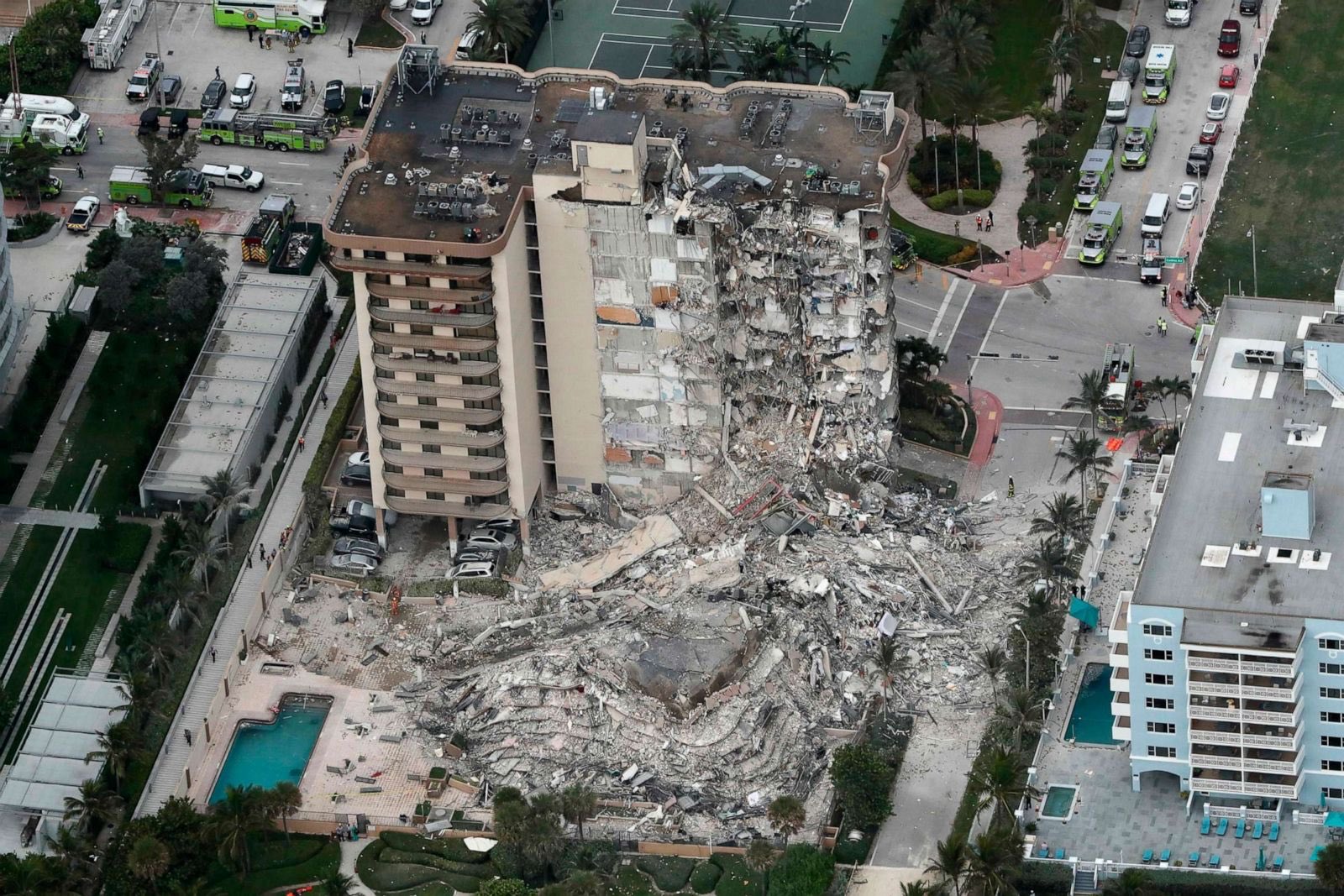
The Champlain Towers South condominium in Surfside, Florida, after its partial collapse on June 24, 2021 — the day after McAfee's death. A viral 2026 X post claims, without evidence, that the building was deliberately destroyed to eliminate McAfee's "dead man's switch." Federal investigators (NIST) attribute the collapse to structural failure. Source: @kingbtc / @ElectBilzerian on X, June 2026. See The Champlain Towers Collapse.
| Field | Details |
|---|---|
| Full Name | John David McAfee |
| Born | September 18, 1945, Cinderford, Gloucestershire, England |
| Died | June 23, 2021 |
| Age at Death | 75 |
| Location of Death | Brians 2 penitentiary, Sant Esteve Sesrovires, near Barcelona, Spain |
| Cause of Death | Hanging |
| Official Ruling | Suicide (Catalan justice department) |
| Nationality | American (naturalized; born British) |
| Killed on US Soil | No |
| Alleged Intelligence Connection | Claimed to possess incriminating data on corrupt officials and governments; widow alleges he was killed rather than allowed to be extradited. No intelligence service has been judicially tied to his death. |
| Victim Was Intel Employee | No |
| Category | Whistleblower (non-intel) / Insider |
Assessment: SUSPICIOUS
McAfee died by apparent hanging in a high-security Spanish prison hours after the National Court authorized his extradition to the United States — a sequence his widow, Janice McAfee, says is inconsistent with the man she knew. He had repeatedly and publicly stated that he was not suicidal and that any reported suicide should be treated as murder, and he had built a public persona around a claimed "dead man's switch" of 31+ terabytes of incriminating data. No declassified document or judicial finding has tied any intelligence service to his death, so his death is rated SUSPICIOUS rather than confirmed.
Circumstances of Death
On June 23, 2021, the Spanish National Court authorized McAfee's extradition to the United States, where he faced federal tax-evasion charges and, separately, a Department of Justice cryptocurrency fraud indictment that could have carried decades in prison. Hours later, McAfee was found dead in his cell at the Brians 2 penitentiary near Barcelona. According to the Catalan justice department, prison medical staff attempted resuscitation without success, and "everything points to death by suicide." A Spanish judge later reported that an autopsy concluded the death was a suicide by hanging.
McAfee's lawyer, Javier Villalba, said the death came as a surprise, telling reporters the family had not seen suicidal signs. His wife, Janice McAfee, publicly rejected the suicide finding.
Background
McAfee founded McAfee Associates in 1987 and built one of the first commercial antivirus companies, making him a multimillionaire and a household name in early consumer cybersecurity. He sold his stake and later distanced himself from the company that bears his name. In his later years he became known for cryptocurrency promotion, two long-shot U.S. presidential campaigns (2016 and 2020), and a chaotic, headline-generating personal life.
The Belize Years and McAfee's Corruption Allegations
In 2008 McAfee moved to Belize. In April 2012, his property was raided by Belize's Gang Suppression Unit (GSU), and he was accused of running a methamphetamine lab and possessing unlicensed weapons. The charges were dropped. McAfee said publicly that he had been targeted because he refused to pay bribes and had been documenting what he described as government corruption in Belize. He alleged that Belizean officials, and Prime Minister Dean Barrow personally, wanted him out of the country or dead. These were McAfee's own claims; the government of Belize denied them, and they have not been established in any court.
In November 2012, McAfee's neighbor, American businessman Gregory Faull, was found shot dead. Faull had reportedly filed a complaint about McAfee's dogs days earlier; McAfee's dogs had died around the same time, and McAfee said they were poisoned. Belize police named McAfee a "person of interest" and sought to question him. McAfee fled Belize, evading authorities through Guatemala. He was never charged with Faull's death and consistently denied any involvement. In 2019, a Florida civil court entered a wrongful-death judgment of roughly $25 million against McAfee in a suit brought by Faull's estate; this was a civil default judgment, not a criminal finding, and McAfee disputed it.
McAfee's spyware-and-corruption claims
The Belize chapter is where McAfee's later "dead man's switch" persona was born. By his own account, before fleeing he ran an amateur intelligence operation against the government that had targeted him. McAfee claimed he had donated computers pre-loaded with keylogging spyware to Belizean police, cabinet ministers' assistants, and other officials, and that he had hired a network of operatives and "spies" to infiltrate the government. He said the intercepted data exposed high-level corruption — allegedly including human trafficking, drug trafficking, money laundering, murder-for-hire, and passport selling reaching into Belizean ministries, and, in some of his retellings, connecting to figures beyond Belize. He said the operation, and the danger it exposed him to, was why he ultimately ran for his life.
These were McAfee's own unverified assertions. They were never established in any court, never independently confirmed, and were denied by the Belizean government. But they are the origin story audiences point to: years before Surfside, McAfee was already telling the world he held stolen evidence of trafficking and corruption by government insiders — the exact narrative later grafted onto the Champlain Towers collapse.
The "Dead Man's Switch"
On June 9, 2019, from his verified @officialmcafee account, McAfee tweeted that he had collected files on corruption in governments and that, "If I'm arrested or disappear, 31+ terabytes of incriminating data will be released to the press." In the same thread he threatened to start naming names and specifics — reportedly beginning with a corrupt CIA agent and Bahamian officials. Critically, the real 2019 tweet named no storage location; it did not mention Florida, Miami, or any building. He repeatedly told followers that he would never take his own life, and he had a tattoo reading "$WHACKD." After his death, an image of the letter "Q" was posted to his Instagram account, which his supporters interpreted as a signal that the switch had been triggered; analysts noted the image's metadata (an "FBMD" string) was standard Facebook/Instagram metadata, not a hidden code, and no 31TB data dump has ever publicly surfaced.
This is the seed of everything that followed. A man with global name recognition had spent years announcing that (a) he held terabytes of proof of elite corruption and trafficking, and (b) if he ever died, it would be murder, not suicide. When he was found hanged in a Spanish cell the day before a Florida high-rise collapsed, that pre-loaded narrative did the rest.
Intelligence Connections
- McAfee framed himself as a holder of compromising material on corrupt officials and governments. Whether such material ever existed has not been verified.
- His widow, Janice McAfee, has stated her belief that her husband was killed to prevent his extradition and testimony, and that he "was not suicidal." She has said his last message to her was that he loved her and would call later that day.
- No intelligence service — American, Spanish, or otherwise — has been judicially or documentarily linked to his death. Claims of intelligence involvement remain allegations and theories, not established facts.
The Champlain Towers Theory
This is the part of the story the audience keeps returning to — the reason McAfee's death is discussed alongside intelligence operations rather than as an ordinary jail suicide. The claim, in one sentence: that McAfee's "dead man's switch" was physically stored in the Champlain Towers South condominium in Surfside, Florida, and that a powerful interest destroyed the building — the day after his death — to bury the evidence. We lay out below what the theory says, why it feels compelling, and exactly where the verifiable facts support or contradict it.
The building and the tragedy
Champlain Towers South was a 12-story beachfront condominium at 8777 Collins Avenue in Surfside, Florida, near Miami Beach — roughly at the intersection of 88th Street and Collins Avenue. Built in 1981, a large section of it partially collapsed in the early morning of June 24, 2021, killing 98 people. It was one of the deadliest non-deliberate building failures in U.S. history. To lay observers watching the surveillance footage, the failure looked sudden and catastrophic — parts of the structure "pancaked" straight down — which is part of why demolition rumors spread so fast. The official death toll is 98 (some viral posts cite a lower "91" figure, which is incorrect).
The timing that started it all
McAfee was found dead in Spain on June 23, 2021. Champlain Towers South collapsed on June 24, 2021 — barely a day later. For an audience already primed by McAfee's years of "if I die, it's murder, and my data goes public" messaging, the sequence read as too neat to be coincidence: the man dies, and within 24 hours a Florida building falls down. That single overlap of dates is the engine of the entire theory.
The fabricated tweet
The theory's central "proof" is a screenshot of a tweet, dated around June 8, 2021, purportedly from McAfee's account:
"If anything ever happens to me, please know that the 31TB of files I have are located on hard drives in my condo near 88th Street and Collins Avenue just north of Miami Beach."
That description matches the collapsed building's location precisely — which is exactly why it went viral. The tweet is fabricated. McAfee posted only two (unrelated) tweets on June 8, 2021, and Wayback Machine / Archive.is captures and advanced searches of his account show no such post ever existed. Analysts concluded the screenshot was created after his death and after the collapse, retrofitting a location onto his genuine (but location-free) 2019 "31+ terabytes" tweet. In other words, the one piece of the story that ties McAfee to that specific building is the one piece that was manufactured.
The "he owned a unit there" claim
A parallel claim held that McAfee — or a supposed son, "Pat McAfee" — owned a unit in Champlain Towers South where the drives were hidden. Miami-Dade County public property records show no ownership by John McAfee, his wife Janice, or any associated entity in the collapsed section of the building. Reporters who checked the records found no connection at all.
The narrative, and who amplified it
The full narrative, as it circulated: McAfee had hidden hard drives proving elite corruption — human trafficking, foreign intelligence involvement, deep-state and financial crimes — and after his "suicide," a powerful interest (variously named as the deep state, the CIA, or Mossad) deliberately brought the building down by controlled demolition or a targeted strike to retrieve or destroy the data, with the residents as collateral. Some versions insisted copies survived elsewhere and still threaten powerful people.
It was amplified heavily in QAnon-adjacent circles. Commentator DeAnna Lorraine characterized it as a "deep state operation." And Surfside's mayor at the time, Charles Burkett, was quoted early on saying the McAfee link was "as good a theory as any other" before it was debunked — a mayoral shrug that theory believers still cite as validation.
How it spread on X and social media
The claim moved across languages and platforms within a day or two of the collapse and still resurfaces years later:
- Direct re-posts of the fabricated "88th Street and Collins Avenue" tweet in multiple languages, including French-language quote-posts reproducing the exact fake text.
- Portuguese and Spanish posts branding it "DEMOLIÇÃO CONTROLADA" (controlled demolition), asserting McAfee kept an apartment there storing "arquivos reveladores sobre o Deep State" (revealing files about the Deep State).
- 2025–2026 revivals such as: "This is the building where John McAfee had an apartment where he hid computer hard drives. After the collapse, the IDF came all the way from Israel to help clean up. This is highly suspicious and I dare say evidence of foul play." Other users hunted for a (nonexistent) video of McAfee "talking about hard drives, files, and a location in Miami." AI assistants and other users debunked these in the replies.
- Threads mixing real building problems (see below) with the conspiracy overlay, and retrofitting McAfee's Belize-era human-trafficking spyware claims into a theory that the Florida drives held the same kind of evidence, expanded to elites and intelligence services.
The IDF angle — the fact that fuels the suspicion
One detail the theory leans on is true: shortly after the collapse, Israel sent a Home Front Command search-and-rescue team to Surfside. It was the first time a foreign military unit participated in a domestic U.S. disaster response. The Israeli specialists helped map the debris pile and assist in search and recovery; their commanders compared the scene to the aftermath of a terror attack because of how the rubble had fallen. The official explanation is straightforward: the unit has world-leading expertise in urban-collapse rescue from earthquakes and conflict zones, the deployment was allied humanitarian assistance (Surfside has a large Jewish community), and it came at U.S. request. No evidence has emerged of any other purpose. But to theorists, a foreign intelligence-adjacent military showing up at the exact building supposedly holding McAfee's files read as a "Mossad cleanup," and it remains the single most-cited "suspicious" element.
Other things people called suspicious
- The timing — McAfee dies June 23, the building falls June 24.
- The IDF deployment — a foreign military at a U.S. domestic disaster for the first time.
- Prior structural warnings ignored — a 2018 engineering report had flagged "major structural damage," "abundant" cracking and crumbling of columns and beams, and a flaw in the original design; repairs were discussed but not completed in time.
- Missing building records — some records reportedly went missing from a rented storage facility, prompting a Surfside police investigation.
- The developer's background — the building's original developer reportedly had a controversial history, described in reports as a fugitive from Canada with tax issues and allegations of financial irregularities.
- The appearance of the collapse — eyewitness videos reportedly showed water and debris falling in the garage minutes before the failure; the progressive collapse looked sudden and demolition-like to non-engineers.
- No explosion was ever confirmed, but early rumors of one, plus the speed of the failure, fed the speculation.
- McAfee's persona — his years of claims about holding dirt on governments and elites, his paranoia, and his explicit "if I die, the data releases" framing made the link instantly plausible to believers.
What the official investigation actually found
The U.S. National Institute of Standards and Technology (NIST) National Construction Safety Team investigated the collapse and released technical findings (updated through June 2026). Its conclusions cut directly against the "instant demolition" reading:
- The collapse was not sudden on June 24. The failure sequence began in early June 2021 — about three weeks earlier — as a progressive failure.
- The initial trigger was punching shear: two connections between garage columns and the pool-deck slab failed as the columns punched through the concrete slab.
- That caused load to redistribute, cracks to grow across the pool deck over the following weeks, and eventually the overload and failure of adjacent slab-column connections that never had enough capacity.
- Root causes were a confluence: severe, widespread deviations in the original 1980s structural design from the codes of the day (inadequate safety margins from day one); further deviations during construction from the design drawings; and decades of deterioration — corrosion driven by salt air, water intrusion, poor waterproofing, added loads, and deferred maintenance.
- NIST explicitly ruled out sinkholes, foundation failure, vibrations from nearby construction, storm surge, and explosions as primary or contributing causes.
No authority found evidence of terrorism, foul play, or deliberate demolition. Officially, this was a progressive structural collapse caused by design, construction, and maintenance failures in a corrosive coastal environment.
The fact-check verdict
Major fact-checking organizations — AP, PolitiFact, Reuters, Snopes, USA Today, AFP, and Gigafact, across June–July 2021 — universally rated the McAfee-condo / hard-drives claims False. Their findings converge: the "88th Street and Collins" tweet was fabricated; property records show no McAfee ownership; and investigators found no evidence of foul play in the collapse.
The honest bottom line
Everything verifiable points away from a McAfee-related cover-up. The one document tying him to the building was faked; the ownership claim fails against public records; and the collapse has a detailed, independent engineering explanation. What remains genuinely unresolved is narrower and more human: a man who spent years insisting he held explosive files and would never kill himself was found hanged in state custody the day before a building fell — and that combination, not any hard evidence, is why the story refuses to die. See the dedicated page: The Champlain Towers Collapse.
Why This Death Raises Questions
- Death occurred within hours of the court approving his extradition, removing him from U.S. jurisdiction permanently.
- McAfee had publicly and repeatedly insisted he would never commit suicide and that any such report should be treated as murder.
- He had cultivated a public "dead man's switch" narrative, giving him both motive to be silenced (in his telling) and incentive to stage drama.
- His widow rejects the suicide ruling.
- He died in custody, where access and surveillance are controlled by the state — a recurring pattern in contested in-custody deaths.
Counterarguments / Alternative Explanations
- McAfee faced the near-certainty of extradition and a lengthy U.S. prison sentence; despair over that prospect is the explanation accepted by Spanish authorities.
- A Spanish judicial autopsy concluded suicide by hanging.
- McAfee had a long, documented history of provocative and theatrical public statements; skeptics argue the "dead man's switch" was self-promotion, and no 31TB release ever materialized.
- The Champlain Towers collapse has a detailed, independent engineering explanation from NIST; linking it to McAfee requires evidence that has not been presented.
Leads for Further Investigation
For readers who want to check the claims themselves, here is where each thread leads:
- Property / tax records — Miami-Dade County public records show no McAfee ownership at Champlain Towers South (confirmed by multiple outlets).
- Twitter / X archives — McAfee's @officialmcafee account via Wayback Machine / Archive.is: the June 2019 "31+ terabytes" tweet exists but names no location; the June 8, 2021 "88th Street and Collins" tweet does not appear in any archive.
- NIST reports — the full National Construction Safety Team technical findings detail the design/construction deviations and explicitly rule out explosion and foul play.
- McAfee's own statements — the 2019 dead-man's-switch tweet, his Belize-era interviews (keylogging spyware and human-trafficking allegations), and his widow's statements disputing the suicide.
- IDF deployment — official Israeli and U.S. statements on the Home Front Command search-and-rescue assistance.
- Building history — the 2018 engineering report, city inspection records, and the developer's background.
- Missing records — Surfside police reports on the storage-facility incident.
- Broader McAfee data claims — any verified releases or lawsuits referencing his files (none has ever been tied to Surfside).
- Conspiracy sources — original social-media posts (screenshots of the fabricated tweet), QAnon/Gab discussions, and YouTube videos repeating the theory.
No credible evidence has emerged linking McAfee to the specific building, to storing drives there, or to the collapse being deliberate. The trafficking-and-officials angle stems from his Belize claims and a general elite-corruption narrative, not from any verified Florida-specific evidence.
Key Quotes
"If I'm arrested or disappear, 31+ terabytes of incriminating data will be released to the press." — John McAfee, on X (then Twitter), June 9, 2019
"I am content in here. I have friends. The food is good. All is well. Know that if I hang myself, à la Epstein, it will be no fault of mine." — John McAfee, on X, October 2020 (referencing Jeffrey Epstein's in-custody death)
"His last words to me were 'I love you and I will call you in the evening.' ... Those are not the words of a man who is suicidal." — Janice McAfee, as reported after his death
See Also
- The Champlain Towers Collapse — the Surfside building disaster the posts tie to McAfee's "dead man's switch"
- Nikolai Mushegian — crypto founder who tweeted warnings of an intelligence "blackmail ring" hours before drowning
- Isaac Kappy — claimed to hold intelligence-linked blackmail files; "if I die, it wasn't suicide"
- Jeffrey Epstein's in-custody death is documented in the Epstein Kill List
Other Shocking Stories
- Nikolai Mushegian: Crypto millionaire drowned hours after tweeting that CIA, Mossad, and "pedo elite" ran a Caribbean blackmail ring.
- Philip Haney: DHS terrorism whistleblower found shot; family disputes the suicide ruling as he prepared to expose more.
- Brandy Vaughan: Merck whistleblower who warned "if something happens to me, it's foul play" — found dead at 44.
- Karen Silkwood: Nuclear whistleblower killed in a car crash while carrying documents to a New York Times reporter.
Sources
- John McAfee found dead in Spanish prison — BBC News
- John McAfee, antivirus software pioneer, dies in Spanish jail — Reuters
- John McAfee 'Q' Instagram Post Sparks Dead Man's Switch Conspiracy — Newsweek
- Belize Murder: Victim Had Confronted John McAfee Over Dogs — ABC News
- John McAfee ordered to pay $25 million over neighbour's death — IT Pro
- John McAfee — Wikipedia
- NIST investigation of the Champlain Towers South collapse
- Surfside condo collapse — Wikipedia
- Fact check: John McAfee did not tweet that files were hidden in the Surfside condo — AP News
- No, John McAfee did not own a unit in the collapsed Surfside building — PolitiFact
- Fact check: Fabricated McAfee tweet ties his data to Surfside collapse — Reuters
- Did John McAfee Tweet About Hard Drives in a Miami Condo? — Snopes
- Israel's Home Front Command aids Surfside search and rescue — Times of Israel
- @ElectBilzerian on X, June 25, 2026 and @kingbtc on X, June 24, 2026
Status: Deceased (2021)
This information was built by Grok and Claude AI research.