Barry Sherman
Canadian billionaire founder of generic-drug giant Apotex, found dead alongside his wife Honey in their Toronto mansion in December 2017. Initially treated as a possible murder-suicide; reclassified by Toronto Police as a "targeted double homicide" six weeks later. The case remains unsolved.
| Field | Details |
|---|---|
| Full Name | Bernard Charles "Barry" Sherman |
| Born | February 25, 1942 |
| Died | December 13, 2017 (bodies discovered December 15, 2017) |
| Age at Death | 75 |
| Location of Death | 50 Old Colony Road, North York, Toronto, Ontario, Canada |
| Cause of Death | Ligature compression of the neck (strangulation by belt around the neck) |
| Official Ruling | Targeted double homicide (Toronto Police, January 26, 2018) |
| Nationality | Canadian |
| Killed on US Soil | No |
| Alleged Intelligence Connection | None established. Speculation in social media posts (e.g., @LightOnLiberty on X, May 2, 2026) has tied the murders to subsequent suppression of hydroxychloroquine during COVID-19; this connection has not been substantiated by police, prosecutors, or any credible investigation |
| Victim Was Intel Employee | No |
| Category | Civilian / Pharmaceutical Industry |
Image Evidence
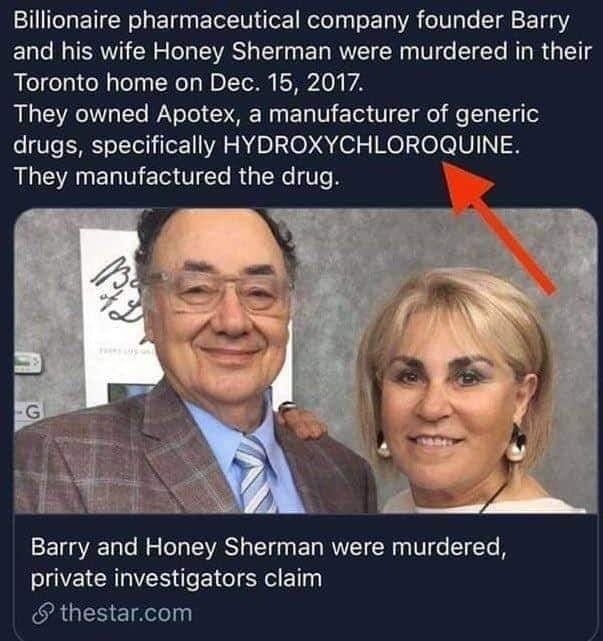
Image of Barry and Honey Sherman, accompanying a social-media post raising questions about the timing of their unsolved 2017 murders relative to the COVID-19 pandemic and the demonization of hydroxychloroquine. Source: @LightOnLiberty on X, May 2, 2026.
Assessment: SUSPICIOUS
Both Barry and Honey Sherman were strangled with belts and posed in their basement pool room in what police initially briefed reporters was a probable murder-suicide. Six weeks later, after the family hired its own forensic pathologist and former homicide investigators, Toronto Police publicly reversed course and classified the case a "targeted double homicide." The killings remain unsolved more than eight years later despite a $10 million CAD private reward — the largest in Canadian history. The Shermans' role at Apotex, Canada's largest generic drug manufacturer and a major producer of generic hydroxychloroquine, has fueled later social-media speculation linking the murders to the COVID-19 era; that speculation is unsupported by any official finding to date.
Circumstances of Death
On the morning of December 15, 2017, a real-estate agent showing the Shermans' Old Colony Road home (which had been listed for sale) discovered the bodies of Barry and Honey Sherman in the basement pool room. Both were seated on the deck of the indoor swimming pool, semi-suspended from a metal railing by leather belts looped around their necks. Their wrists showed signs that they had been bound but no ligatures were on the bodies when found. There were no signs of forced entry into the home.
According to reporting by the Toronto Star, the Globe and Mail, and Toronto Life:
- The first officers on scene briefed media that the deaths appeared consistent with a murder-suicide. Anonymous police sources told several outlets they were exploring that theory as the leading scenario.
- The Shermans' four children publicly rejected the murder-suicide framing within days, calling it inconsistent with their parents' lives and behavior.
- The family retained Brian Greenspan, a prominent criminal lawyer, who in turn assembled a private investigative team including former Toronto Police homicide detective Tom Klatt and pathologist Dr. David Chiasson, the former Chief Forensic Pathologist of Ontario.
- The private team conducted second autopsies and concluded both Shermans had been killed by another person or persons.
- On January 26, 2018, Toronto Police Chief of Detectives Susan Gomes publicly announced the case was a "targeted double homicide" — both Shermans had been "targeted." Gomes explicitly thanked the family's investigators for their work.
In 2018 the family offered a $10 million CAD reward — the largest privately-funded reward in Canadian history — for information leading to an arrest and conviction. Despite this, no charges have been laid.
In 2021 a Toronto Police press conference released a video of a "person of interest" walking near the home on December 13, 2017. No identification has been made public.
Background
Apotex
Barry Sherman founded Apotex Inc. in 1974 in Toronto. Under his leadership it became Canada's largest pharmaceutical company and one of the world's largest generic drug manufacturers, producing roughly 300 generic medicines distributed in more than 115 countries. At the time of his death his net worth was estimated by Canadian Business at approximately $4.77 billion CAD, making him one of the 15 wealthiest Canadians.
Apotex's business model — entering markets with low-cost generic versions of brand-name drugs as soon as patents allowed (and sometimes contesting them in court) — put Sherman in regular litigation with major pharmaceutical companies for decades. He was personally named in dozens of lawsuits across Canada, the United States, and Europe.
Apotex manufactured generic hydroxychloroquine (an antimalarial drug long used for lupus and rheumatoid arthritis) under the brand name Apo-Hydroxyquine, and was a significant supplier in Canada and several other markets. For more on the broader hydroxychloroquine controversy, see Hydroxychloroquine and COVID-19.
Family Disputes and Lawsuits
Sherman had been embroiled in long-running litigation with cousins (the Winter and Barkin families) who claimed they were entitled to a share of Apotex under a 1967 agreement involving Sherman's late uncle. The Supreme Court of Canada ruled against the cousins shortly before Sherman's death.
He was also being deposed in a lawsuit involving Liberal Party fundraising at the time of his death.
Honey Sherman
Anna "Honey" Sherman (née Reich) was Barry's wife of 47 years. A philanthropist active in Jewish charities, women's organizations, and hospital boards in Toronto, she was 70 at the time of her death.
What the Investigation Has Established
Per Toronto Police statements, court filings, and reporting by Canadian media:
- The deaths were homicides, not a murder-suicide.
- Both victims were "targeted."
- The killer or killers entered without forced entry, suggesting either a key, an unlocked door, or an invitation.
- Police have publicly identified no suspect by name, though a "person of interest" video was released in 2021.
- Toronto Police have rejected family criticism that the initial investigation was botched, but the family has been publicly critical of the original handling.
Why This Death Raises Questions
- A double homicide of two prominent Canadians remains officially unsolved more than eight years later despite a $10 million CAD reward.
- The initial police framing as a likely murder-suicide — quickly leaked to media — was reversed only after the family's own forensic team produced findings to the contrary.
- No forced entry, suggesting access by someone known to the Shermans or with means to enter unobserved.
- Sherman was simultaneously involved in major civil litigation, intra-family inheritance disputes, and was a prominent Liberal Party donor and friend of Prime Minister Justin Trudeau — multiple distinct potential motives, none established.
- The killings preceded the COVID-19 pandemic by roughly two years; later social-media commentary has linked Apotex's role as a major North American producer of generic hydroxychloroquine to the timing, though no investigation has established such a link.
Additional Account
A contributor to this investigation, who lived in the Greater Toronto Area at the time of the Sherman killings and later returned to Florida, submitted the following recollection (May 2, 2026):
"I was living in the GTA at the time of this double murder. They were rare up there then. When COVID hit, I remembered the case. I was back home in Florida by then.
The 'known culprit' had the matter SEALED by the Court.
Now Canada will arrest you for possession on these drugs — it undercuts their Big Pharma."
These are personal observations and circulating claims, not findings of this investigation. For accuracy, the following context applies:
- GTA double-homicide rarity: Toronto and the wider GTA have historically had low homicide rates for a city of their size. No source quantifies a "rare" framing for December 2017 specifically, but the Sherman case attracted unusual media coverage in part because targeted homicides of prominent figures in private homes are unusual in the region.
- "Known culprit" and sealed court records: Toronto Police have publicly identified no suspect by name as of 2026. A "person of interest" video was released in 2021. Multiple Sherman-related court files have been the subject of sealing orders — most notably a probate sealing application that the Toronto Star successfully challenged in Sherman Estate v. Donovan, 2021 SCC 25, where the Supreme Court of Canada ruled against blanket sealing of the estate file. Search-warrant information-to-obtain (ITO) materials in the homicide investigation remain sealed at the request of police and the Crown, citing the ongoing investigation. No public court order names any "culprit." The contributor's "known culprit" framing is not corroborated by any public record.
- Canadian hydroxychloroquine possession claim: As of 2026, hydroxychloroquine is a prescription-only medication in Canada under the Food and Drugs Act (Health Canada's Prescription Drug List). It is not scheduled under the Controlled Drugs and Substances Act, so simple possession with a valid prescription is lawful. During the COVID-19 period, Health Canada and several provincial colleges issued guidance restricting HCQ prescribing for COVID-19 outside clinical trials. The investigation is not aware of any general criminal-arrest power for HCQ possession in Canada. The contributor's framing is documented here as their stated view, not as a finding.
The recollection is preserved because the contributor was geographically and temporally proximate to the case and personally noted the COVID-era thematic connection that this investigation is now examining.
The Hydroxychloroquine / COVID-19 Speculation
Beginning in 2020, social-media posts — including the May 2, 2026 post by @LightOnLiberty that prompted this entry — have raised questions about whether the Sherman murders relate to subsequent events around the COVID-19 pandemic and hydroxychloroquine.
Posts in this category claim, in summary form:
- That Apotex was Canada's primary or sole large-scale producer of generic hydroxychloroquine.
- That the Shermans were murdered shortly before COVID-19 and the public dispute over hydroxychloroquine.
- That hydroxychloroquine was subsequently "demonized" via media coverage and revoked emergency-use authorizations.
These claims have not been substantiated by any criminal investigation, official inquiry, or peer-reviewed source as a motive for the killings. Toronto Police have made no public statement linking the murders to the pharmaceutical industry, hydroxychloroquine, or the COVID-19 pandemic. The motive for the killings remains officially unknown.
This profile documents the speculation as a circulating claim — readers should weigh it against the absence of corroborating evidence.
Counterarguments / Alternative Explanations
Multiple non-intelligence motives have been publicly canvassed:
- Civil litigation enemies: Sherman had decades of contentious patent and contract litigation with brand-name pharmaceutical firms, business partners, and former employees.
- Family inheritance disputes: The cousins' lawsuit had concluded shortly before his death, but other intra-family disputes existed.
- Personal enemies in business: Sherman had a reputation for combative dealings.
- Random or contracted homicide: Some Canadian commentators have suggested a contract killing tied to a specific business dispute.
No motive has been confirmed by police.
Key Quotes
"Our parents shared an enthusiasm for life and commitment to their family and community totally inconsistent with the rumours regrettably circulated in the media as to the circumstances surrounding their deaths." — Sherman family statement, December 2017
"Both Barry and Honey Sherman were, in fact, targeted." — Toronto Police Chief of Detectives Susan Gomes, January 26, 2018
"Who murdered Barry and Honey Sherman — owners of Canadian company Apotex — Canada's ONLY manufacturer for cheaper and more effective Hydroxychloroquine? They were brutally murdered in their home before the Covid-19 pandemic was released and Hydroxychloroquine was demonized!" — @LightOnLiberty on X, May 2, 2026 (an unverified social-media claim raising questions; not a finding of any investigation)
See Also
- COVID-19 — pandemic-era topic page covering the public-health, regulatory, and policy disputes that this case has been linked to in social-media commentary
- Hydroxychloroquine — topic page on the antimalarial drug, its COVID-19 controversy, and Apotex's role as a generic producer
- Brandy Vaughan — former Merck sales rep and pharmaceutical-industry critic who died in 2020 after years of documented stalking
- David Kelly — UK weapons inspector whose death is widely cited as another high-profile, contested ruling
Other Shocking Stories
- Brandy Vaughan: Former Merck rep predicted her own death after years of stalking. Found dead at 44 of sudden blood clots.
- Karen Silkwood: Nuclear whistleblower carrying evidence to the New York Times — forced off the road and killed.
- Edmond Safra: Billionaire banker died in a Monaco fire after his Mossad-trained security was conveniently absent.
- Danny Casolaro: Told friends "if anything happens to me, it's not suicide." Found with wrists slashed in a hotel.
Sources
- Barry Sherman — Wikipedia
- Murders of Barry and Honey Sherman — Wikipedia
- Toronto Police announce Sherman case is "targeted double homicide" — CBC
- Inside the Sherman murder mystery — Toronto Life
- Police release person-of-interest video in Sherman case — CBC
- Apotex Inc. — Wikipedia
- Sherman family offers $10M reward — Globe and Mail
- @LightOnLiberty on X (May 2, 2026) — social-media post raising questions about Apotex, hydroxychloroquine, and the timing of the murders
This information was built by Grok and Claude AI research.
Status: Deceased (2017)