Terrance Yeakey
Oklahoma City police sergeant and first responder to the 1995 Murrah Federal Building bombing, found dead in a field near El Reno, Oklahoma on May 8, 1996 — three days before he was scheduled to receive the OCPD Medal of Valor. His death was ruled a suicide despite eleven cuts across his arms, neck, and wrists, a downward-trajectory gunshot wound to the head, no autopsy, and no suicide note.
| Field | Details |
|---|---|
| Full Name | Terrance Eugene Yeakey |
| Born | November 9, 1965 |
| Died | May 8, 1996 |
| Age at Death | 30 |
| Location of Death | Field near Fort Reno Road, El Reno, Oklahoma |
| Cause of Death | Gunshot wound to right temple; eleven incised wounds to wrists, arms, and neck |
| Official Ruling | Suicide (no autopsy performed) |
| Nationality | American |
| Killed on US Soil | Yes |
| Alleged Intelligence Connection | FBI and ATF (alleged by family and fellow officers; agencies have not publicly responded) |
| Victim Was Intel Employee | No |
| Category | Whistleblower (non-intel) / First Responder |
Assessment: HIGHLY SUSPICIOUS
According to family members and fellow Oklahoma City Police Department officers interviewed by CNN's Thomas Lake in 2023, the official suicide narrative requires a man with both wrists slashed and his throat cut to walk roughly half a mile through a field, then shoot himself in the head with a downward bullet trajectory. No autopsy was performed on the unattended death of a police officer, no suicide note was found, and the full investigative report has never been publicly released. His ex-wife Tonia Yeakey-Rivera and named officers Jim Ramsey, Steve Vassar, and Don Browning continue to publicly state they do not believe he killed himself. The FBI, ATF, and Oklahoma City Police Department have not publicly responded to allegations of federal harassment, missing reports, or pre-death surveillance.
Image Evidence
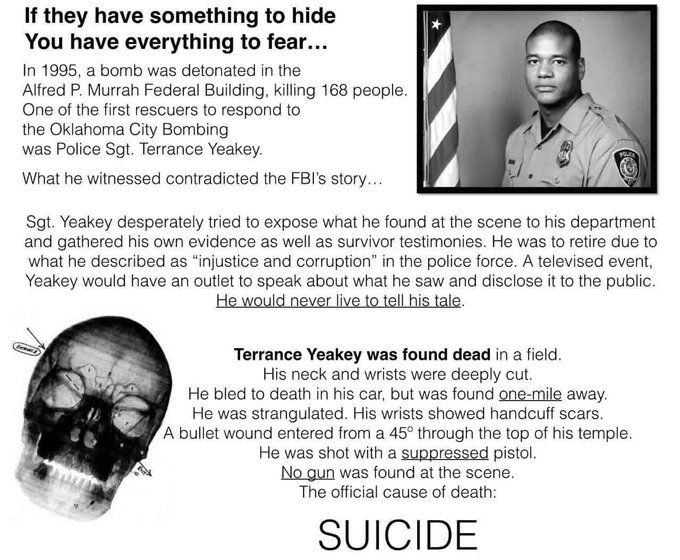
Memorial image of Officer Terrance Yeakey shared on the 30th anniversary of his death. Source: @JasonBassler1 on X, May 8, 2026.
Circumstances of Death
According to CNN's 2023 long-form investigation, Yeakey's body was discovered in a field roughly half a mile to a mile-and-a-half from his abandoned maroon Ford Probe, which was found near Fort Reno Road in the area of the El Reno federal correctional institution. Inside the car, investigators reported finding a Bible, an empty holster, a blood-covered razor blade, and what was described as 2–3 liters of his blood. Some accounts also describe the car's seats as unbolted, the floorboards torn up, and side panels removed.
The medical examiner's stated probable cause of death was a single gunshot wound to the right temple at a downward 45-degree angle. The body also showed what was officially described as "multiple superficial incised wounds" to the wrists, arms, and neck. Citizen-investigator and documentary outlets, including the 2011 film A Noble Lie: Oklahoma City 1995, describe these as eleven slashes across the wrists, arms, and elbows, plus stab wounds on both sides of the neck near the jugular. According to Tonia Yeakey-Rivera, she was told the body also bore rope burn on the neck, ligature marks on the wrists consistent with handcuffs, and muddy grass embedded in the slash wounds. No autopsy was performed. No suicide note was found.
Yeakey was scheduled to receive the Oklahoma City Police Department Medal of Valor three days later, on May 11, 1996, for his actions at the Murrah Federal Building on April 19, 1995.
Background
Terrance Eugene Yeakey was born November 9, 1965, in El Reno, Oklahoma. He served in the U.S. Army, including time in Saudi Arabia, before joining the Oklahoma City Police Department in 1989. By April 1995 he held the rank of sergeant.
On April 19, 1995, Yeakey and Officer Jim Ramsey were among the very first officers to arrive at the Alfred P. Murrah Federal Building after the 9:02 a.m. truck bombing that killed 168 people. Yeakey personally pulled multiple survivors from the wreckage. CNN documents him keeping maintenance worker Randy Ledger alive after Ledger's carotid artery and jugular vein were severed, and reaching trapped survivor Richard Williams. Tonia Yeakey-Rivera has stated she believes he saved between six and eight people in total. During the rescue effort, Yeakey fell through two collapsed floors and seriously injured his back, an injury that persisted until his death thirteen months later.
Intelligence Connections
According to Tonia Yeakey-Rivera, his sister Lashon Yeakey, and named OCPD officers, Yeakey grew increasingly suspicious of the official lone-bomber narrative in the months following the bombing. Reported claims attributed to him by these sources include:
- That damage patterns in the Murrah building suggested explosions originating inside the structure rather than only from an external Ryder truck bomb.
- That federal agents in tactical gear arrived implausibly quickly after the blast.
- That he wanted to revisit the daycare area at night to examine evidence himself.
Officer Steve Vassar told CNN he personally saw two people in the cab of the Ryder truck — contradicting the lone-actor account. Other early witnesses reported a helicopter circling before the blast.
According to family accounts published by CNN, BatesLine, and A Noble Lie, Yeakey wrote a nine-page report shortly after the bombing documenting his observations and concerns. A supervisor allegedly demanded he replace it with a one-page version. The original nine-page report reportedly disappeared from police files, and Tonia stated a supervisor called her hostilely and threatened reprimand if Yeakey did not submit the shorter version.
According to Tonia and witness Romona McDonald, Yeakey had told family members that federal agents — described as likely FBI or ATF — stopped him when he returned to the bombing site at night, with one allegedly saying, "You're not supposed to be back down there." Tonia reported that her home was burglarized and she heard clicking on her phone line. McDonald, who said she met Yeakey near the El Reno federal prison the day he died, also reported a burglary and surveillance. The FBI, ATF, and DOJ have not publicly responded to these allegations.
Why This Death Raises Questions
- The body was found roughly half a mile to a mile-and-a-half from his car, requiring him to walk that distance with both wrists and his throat cut, before a final gunshot to the head.
- The gunshot trajectory was described as downward through the right temple at a 45-degree angle — an unusual self-inflicted angle.
- No autopsy was performed on the unattended death of an active-duty police officer.
- No suicide note was found.
- According to Tonia, the body bore rope burn on the neck and ligature marks on the wrists consistent with handcuffs — neither of which is consistent with a self-inflicted death scene.
- The full investigative report has never been publicly released.
- He was three days from receiving a Medal of Valor — an unusual moment to take one's life.
- According to family accounts, his original nine-page bombing report was missing from police files.
- According to Tonia and McDonald, both reported burglaries and surveillance in the period before his death.
- Yeakey reportedly told Tonia his "days were numbered" and asked her to leave with him in the middle of the night shortly before his death.
Counterargument / Official Explanation
Officer Jim Ramsey himself has acknowledged in interviews that an alternative theory exists: that Yeakey suffered profound survivor's guilt and post-traumatic stress over his inability to save more victims, combined with a contested family-court situation in which he had been barred from seeing his two young daughters. The Oklahoma medical examiner's office and Oklahoma City Police Department have stood by the suicide ruling, and the case has not been reopened despite renewed media attention from CNN's 2023 reporting and the A Noble Lie documentary.
Family Statements
"I think they murdered Terry because he knew too much. Mama, they executed him." — Lashon Yeakey, Terrance's sister, as quoted by CNN.
"Whatever problems we had were prior to the bombing. This is a simple murder case. He's entitled to have his death certificate changed to reflect that he did not kill himself." — Tonia Yeakey-Rivera, ex-wife, as quoted by CNN.
"Tonia, it's not what they're saying it is. They're not telling the truth." — Quote attributed to Yeakey by Tonia Yeakey-Rivera, describing what he told her after the bombing.
Officer Statements
"No. I guess I don't." — Officer Jim Ramsey, when asked by CNN whether he believed the suicide ruling.
"I still don't believe Terry did it." — Officer Steve Vassar, as quoted by CNN.
"I still think he was murdered." — Officer Don Browning, as quoted by CNN.
Other Suspicious Deaths Around the OKC Bombing
According to public reporting compiled by Wikipedia, All That's Interesting, and other outlets, several other individuals connected to the OKC bombing investigation died under unusual circumstances:
- Kenneth Michael Trentadue — Found hanged in his Federal Transfer Center cell in Oklahoma City on August 21, 1995; body was reportedly covered in cuts, bruises, and strangulation marks. Family awarded $1.1M for emotional distress; many alleged he was mistaken for ARA member Richard Lee Guthrie.
- Richard Lee Guthrie — Aryan Republican Army member tied to the McVeigh circle; found hanged in his cell in July 1996.
- Mike Loudenslager — General Services Administration planner whose body was found on the first floor of the Murrah building. Multiple witnesses (Jack Colvert, Jackie Majors, Buddy Youngblood) reportedly stated they saw him alive after the 9:02 a.m. blast — raising questions about his official status as a bombing victim.
- Dr. H. Don Chumley — First-responder physician; died in a 1995 plane crash.
- Glenn Wilburn — Grandfather of two children killed in the Murrah daycare; conducted independent investigation; died of cancer in 1997.
See Also
- Phil Schneider — Self-described government whistleblower who died the same year (1996) with all his research materials stolen.
- Bill Cooper — Conspiracy researcher shot by sheriff's deputies in 2001; had publicly warned of major US attacks.
- Karen Silkwood — Nuclear whistleblower whose suspicious car crash en route to a reporter remains contested.
Other Shocking Stories
- Phil Schneider: Geologist found strangled with a catheter tube weeks after publicly saying any "suicide" of his was murder.
- Gary Webb: Pulitzer-contributing journalist found shot twice in the head after exposing CIA-Contra cocaine; ruled suicide.
- Danny Casolaro: Investigator told friends "if I die, it wasn't suicide" — found with wrists slashed in a hotel room.
- Job Price: SEAL Team 4 commander; four forensic experts said the Afghanistan "suicide" scene was staged.
Sources
- Why did this cop turn up dead? — Thomas Lake, CNN, March 2023
- Terrance Yeakey — Wikipedia
- Sergeant Terrance Yeakey — National Law Enforcement Officers Memorial Fund
- Find a Grave — Terrance Eugene Yeakey
- A Noble Lie: Oklahoma City 1995 (2011) — Free Mind Films, dir. James Lane
- @JasonBassler1 — 30 years ago today — May 8, 2026
- Generation Why Podcast Ep. 582 — Terrance Yeakey — Wondery
- Death of OKC bombing responder prompts new investigation — UCentral Media, March 2023
Status: Deceased (1996)
This information was built by Grok and Claude AI research.